Not Just a Stretched H6: The "Segment-Breaking Engineering" of the All-New Haval H6L I. Vehicle Positioning & Architecture: What Exactly Is It from "H6" to "H6L" From the specs, the H6L is essentially a front-engine, front-wheel-drive mid-size SUV pulled upward from the existing transverse platform: Dimensions: 4800×1895×1730mm, wheelbase 2810mm, over 70mm more than the current H6's wheelbase, already standard mid-size. Suspension: Front MacPherson independent + rear multi-link independent, the mainstream and also higher-tier solution for this class. In engineering terms, the advantage of this "making an L version on a mature platform" approach is clear: R&D costs and risks are significantly reduced: body-in-white, stamping footprint, just adjust the wheelbase and rear suspension structure. Supply chain and validation system follow the H6 family:
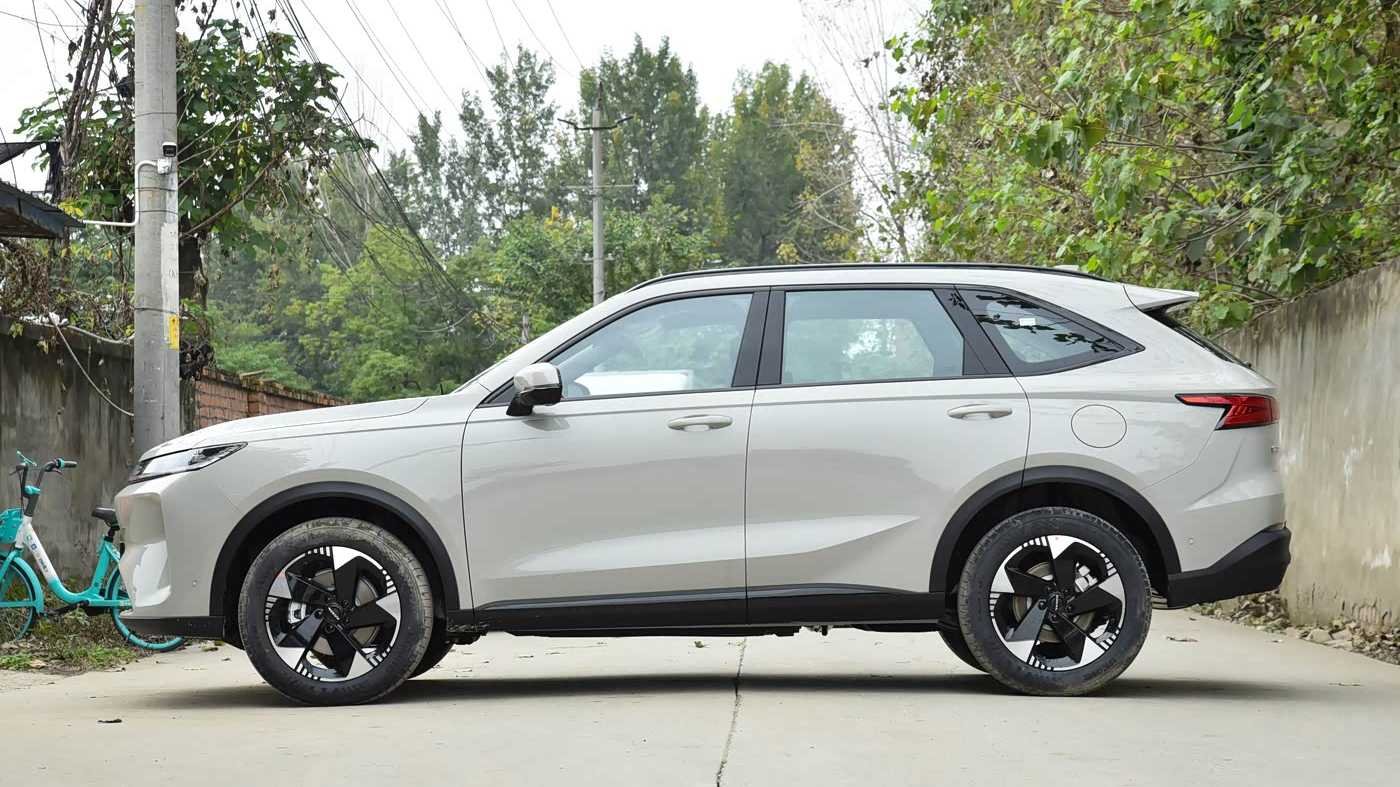
I. Vehicle positioning & architecture: What exactly is it, from "H6" to "H6L"
From the parameters, the H6L is essentially a front-engine, front-wheel-drive midsize SUV stretched upward from the existing transverse platform:
Dimensions: 4800×1895×1730 mm, wheelbase 2810 mm, more than 70 mm longer than the current H6's wheelbase, already standard midsize.
Suspension: MacPherson independent front + multi-link independent rear, which is the mainstream and also the higher-grade solution in this class.
In engineering terms, the benefits of this "making an L version on a mature platform" approach are very clear:
R&D cost and risk are greatly reduced: just adjust the body-in-white, stamping footprint, wheelbase, and rear suspension structure.
The supply chain and validation system follow the H6 family: NVH, durability, corrosion, and waterproofing all have mature experience.
Product differentiation relies on "length + equipment + powertrain": directly filling the gap in the 100,000–150,000 yuan class midsize gasoline SUV segment.
So from an engineering perspective, the H6L is not "a new car developed from scratch," but a high-intensity facelift + class upgrade, with the focus on:
Redoing the packaging for space and comfort;
Using Great Wall's latest-generation 2.0T + 9DCT in the powertrain;
The lower structure, active safety, and intelligent cockpit benchmark a "family main car" rather than a "personal toy car."
II. Body and safety: 82% high-strength steel + full-frame subframe, the Libyan underpinning
1. Body materials and stiffness
The several key figures officially given are actually very "engineering":
High-strength steel usage: 82%
Key areas (A/B pillars, etc.) use 1650 MPa hot-formed steel
Body torsional stiffness: 19000 N·m/°
What does this mean?
82% high-strength steel: at the 100,000–150,000 yuan price point this is very aggressive; usually many cars in this range hover around 60–70%. The direct benefits of a higher proportion of high-strength steel are:
Collision deformation is more controllable, and the occupant cell boundary is better;
Torsional stiffness rises, making structural tuning (especially suspension hard points) more harmonious.
1650 MPa hot-formed steel: this strength level is already "serious-grade" terminology, commonly seen in the A/B pillars and door ring structures of luxury brands. It helps with rollovers, side impacts, and pole collisions.
19000 N·m/° torsional stiffness: for a transverse front-wheel-drive midsize SUV, this value is on the high side, indicating that the body-in-white structure has a certain degree of "over-design"—the benefit is that there is still potential for an upgraded version with PHEV or 7-seat expansion.
2. Structural layout and subframe
One point is crucial: the official information clearly mentions a 3DP cage body structure + full-frame subframe + front-end "frame mouth" shaped defense line.
3DP cage cabin: this can be understood as longitudinal beams + engineered structures + multi-path force transfer, routing collision energy "around" the occupant cell.
Full-frame subframe: more costly than the "yuánbǎo liáng" still used by many cars, with the advantages:
Higher suspension hard-point stiffness, geometry less prone to drift, and more stable handling and NVH;
In a frontal crash, the subframe also participates in deformation as an energy-absorbing component, reducing the concentrated load on the body's longitudinal beams.
Engine compartment energy absorption improved by 10%: in engineering terms, this means there is a specially designed "controllable defect" at the junction of the front longitudinal beams, crash boxes, and subframe.
From a safety engineer's perspective, the logic of this combination is very complete: a high-stiffness occupant cell + front-end controllable crumple + high-stiffness suspension hard points, combined with L2-level 25-item active safety. On the H6L, Haval wants to shine the "Safety Great Wall" sign again.
III. Styling & waistline: focused on a comfort-led "large five-seat" layout
1. Suspension type and geometry
Front suspension: MacPherson independent
Rear suspension: multi-link independent
Wheelbase: 2810 mm
In this class, this is the most balanced combination of cost and performance.
The engineering focus is probably on these things:
Long wheelbase + large five-seat layout
The wheelbase has been increased from the H6 to 2810 mm, with the direct benefits being straight-line stability, rear left-side space, and comfort.
For tuning, the long wheelbase gives engineers greater "vibration-filtering travel space," allowing the initial suspension stroke to be softer without being too "floaty."
Full-frame subframe with multi-link
The rear multi-link more easily achieves a "stiff laterally, soft longitudinally" character: lateral support controls body attitude in corners, while longitudinal compliance lets the wheels gently cross expansion strips.
The full-frame subframe has high stiffness, which benefits NVH: road impacts do not "bounce" on the subframe before being transmitted to the body.
Sudden point: comfort > limit control
This is not an SUV meant for lap times; its customer image is "the main car for a family with elders, kids, and children."
The tuning setup is more likely to be:
Low-speed fine vibrations are gently filtered out;
Medium-speed undulations do not easily cause head toss;
Steering gives a bit of "viscous feel" to inspire confidence in the driver, rather than feeling like a compact sports car at high speed.
If you later test-drive it, from an engineering perspective you can deliberately experience: the rear-seat gravity arm, the impact of rough roads on interior noise, and the full-frame subframe's performance regarding rattles on gravel roads.
IV. Powertrain: the "flagship hand-me-down" of the sixth-generation 2.0T + second-generation 9DCT
1. Core hardware parameters
2.0T version:
Engine: sixth-generation 2.0T (GW4N20A)
Maximum power: 175 kW
Maximum torque: 385 N·m
Thermal efficiency: 38.3%
Transmission: second-generation 9DCT wet dual-clutch
Maximum speed ratio span: 8.13
Transmission efficiency: about 96%
Official data:
0–100 km/h: 7.2 seconds
WLTC combined fuel consumption: 7.4 L/100km (about 0.5 yuan/km)
1.5T version:
Maximum power: 135 kW
Maximum torque: 275 N·m
Paired with a 7-speed wet DCT, serving as the volume model.
2. Engineering highlights of the 2.0T engine
The several technologies officially promoted are actually all about "combustion + reducing losses":
Miller cycle: by delaying intake valve closing and the entire effective compression stroke, it increases the effective compression ratio and expansion ratio, doing more work with less consumption.
Intelligent thermal management system: electronic water pump + electronic thermostat + split-flow control, improving warm-up time by about 20% and further reducing fuel consumption by 0.2 L/100km.
Center-mounted spark plug: improved template core generation and sustained combustion duration, critically important for highly lean combustion.
High-temperature-resistant turbocharger (1050°C) + short intake port (72.6 mm): improves turbo response and continuous operation capability under high load, reducing turbo lag.
From an engineering perspective, this is a 2.0T focused on "broad thermal efficiency":
It is not for peak power, but for pulling efficiency to a relatively high level **"under WLTC and daily operating conditions"**;
The official information gives fuel-consumption benefits corresponding to multiple technical improvements, which is also a typical engineering approach of layered targets stacked one by one.
3. 9DCT: the significance of gear ratio range and control strategy
9 gears + a speed ratio span of 8.13 means:
At launch, a very large overall transmission ratio can be used to make the car "light and brisk";
At high-speed cruising, engine speed can be reduced very low (officially advertised at about 1800 rpm at 120 km/h), directly targeting high-speed fuel consumption and NVH.
Wet dual-clutch + military-grade gear steel is more of a reliability endorsement:
What dual-clutches fear is thermal degradation and bearing issues; a wet design can use oil for bearing and lubrication;
High-strength gear steel corresponds to greater coordinate margin and fatigue resistance.
A 200 ms start-stop response is actually the result of good start-stop + shift control, belonging to the calibration and software team's efforts.
Combined with validation data such as the Ring Taklimakan, Dunhuang Rally 5000 km, engine 33 days of 24-hour bench durability, and a minimum of 3.45 million km, the judgment is that the system assembly has already "endured a lot of hardship" elsewhere, and the H6L represents the application and scaling of mature technology.
V. NVH and thermal management: engineering details serving the "large five-seat" positioning
To support the slogans "library-level quietness" and "mobile comfort zone," the H6L has made impressive visible efforts in NVH and thermal management:
Acoustic package:
Front-row dual-layer laminated glass;
3 door seals;
About 30 locations of sound insulation/absorption materials.
Wind resistance control: vehicle drag coefficient Cd ≈ 0.366, relatively low among traditional gasoline SUVs.
The streamlined roof, "meteor piercing the sky" shoulder line, and other designs are not just aesthetic, but also for reducing vortices.
Cabin thermal comfort:
Full-vehicle seat heating + steering wheel heating;
Front-row ventilation + 8-point massage + dual-density labeling;
Intelligent hot-and-cold refrigerator, etc. (some versions).
From an engineering perspective, this is a typical "comfort stacking" solution:
Through the combined effect of structure + materials + air conditioning/thermal system, controlling the temperature and noise perceived by occupants;
Achieving such acoustic and thermal comfort configuration at the 100,000–150,000 yuan price point shows that Haval clearly positions this car's core selling point as a family mainstay, not a handling machine or off-roader.
VI. Intelligence and E/E architecture: pushing Coffee OS down as a "flagship component"
Although what you provided is mainly a description of configuration elements, combined with public information, several engineering loads of the H6L in the intelligent section can be seen:
Computing platform:
14.6-inch central control screen + 12.3-inch instrument cluster;
16 GB RAM;
Equipped with the Coffee OS 3 infotainment system (reported by some media).
Human-machine interaction:
250 ms voice wake-up, parsing multiple meanings in one utterance (one sentence, ten meanings);
"See and say" means the voice system is strongly bound to the UI layer, requiring a unified software architecture.
Ecosystem and connectivity:
Supports Huawei HiCar, Apple CarPlay, and Xiaomi ICCOA; this infotainment system must be compatible with multiple protocols, which is a challenge for the underlying network and security strategy;
Intelligent driving and parking:
L2-level + 25 active safety features; the camera + radar combination is fairly conventional;
Automatically completing parking recognition for 200+ types of parking spaces, with the fastest park-in in 28–30 seconds; behind this is the capability of environmental modeling and path-planning algorithms.
For engineers, the key to the H6L's intelligent section is: it did not take the cutting-edge route (such as lidar + high-level navigation assist), but instead squeezes the experience out of a mature L2 system, while doing well the "high-frequency essential" functions such as voice, infotainment, and parking.
VII. Summary: This is an engineering car whose costs have been calculated very clearly
Looking at the H6L from an engineering perspective, I would give it these labels:
Platform risk and maturity
It continues to revolve around the transverse front-wheel-drive + front MacPherson/rear multi-link platform, rather than making a great leap forward.
Money was spent "in places you cannot see"
The proportion of high-strength steel, hot-formed steel, full-frame subframe, 3DP cage skeleton, and 0.366 drag coefficient are not things users can see at first glance, but they have long-term value for safety, NVH, and fuel consumption.
The powertrain is the real technical selling point
The sixth-generation 2.0T + second-generation 9DCT is currently a relatively "sharp" set within Great Wall's own gasoline system, focusing on a "gasoline 2.0T with hybrid-level fuel consumption."
Styling and intelligence take the steady route
Suspension setup and comfort orientation, equipped with a large five-seat space, fully aimed at family users;
The modification is not about "stacking hardware," but about base navigation for high-frequency functions such as L2 + infotainment + voice + parking.
相关文章

昆明车帮
Starting at 92,900 yuan, Geely's fourth-generation Boyue L launches in Kunming with first batch of user deliveries

柿柿车
Tesla Q3 in One Earnings Report: Steady Delivery Growth, Robotaxi, Energy Storage, and Robotics All Accelerating

智电大V
More off-road than family cars, smarter than off-roaders, M-Hero X700 arrives, limited-time starting at 209,800 yuan