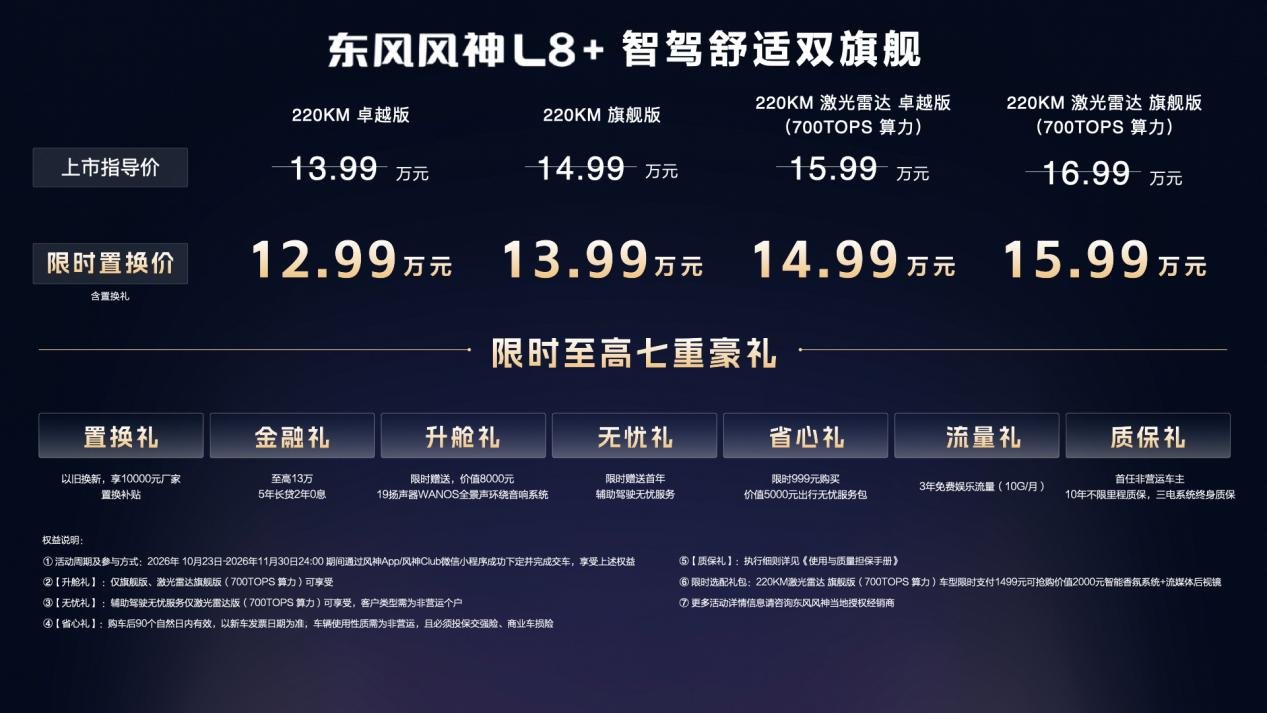
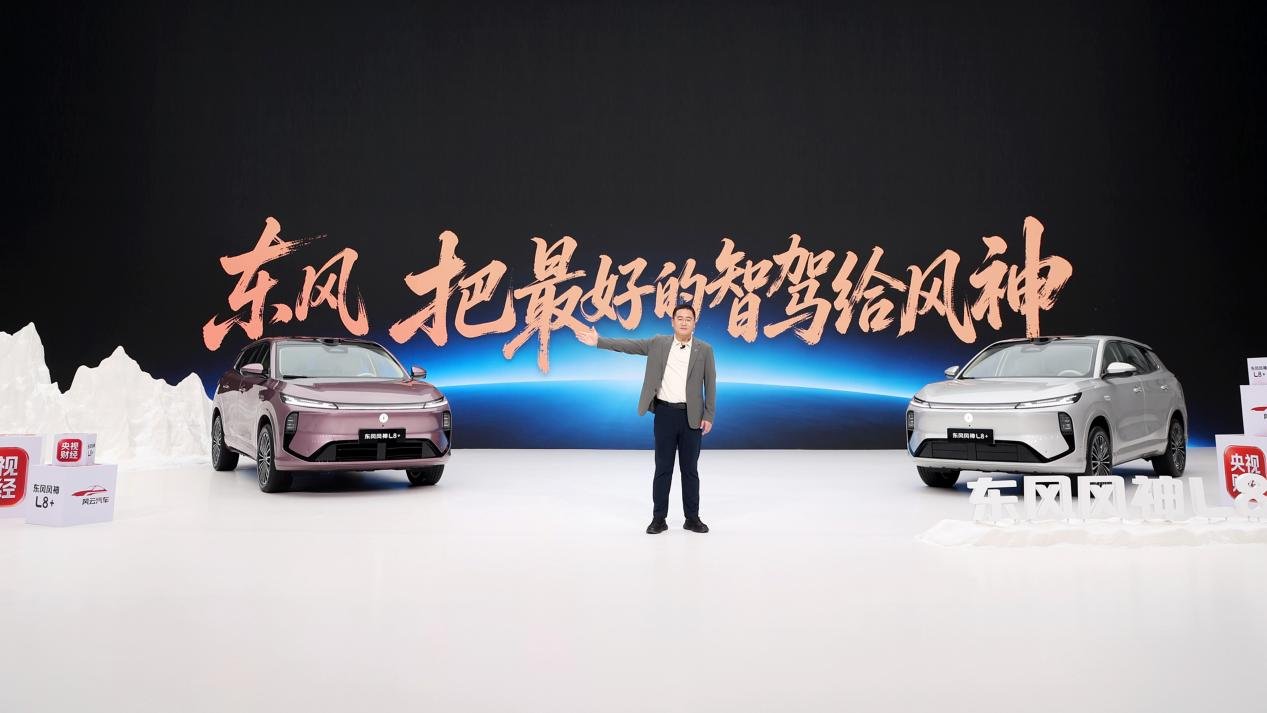
On October 23, the Dongfeng Aeolus L8+ was officially launched, with a limited-time trade-in price of 129,900 yuan to 159,900 yuan. Witnessed live by CCTV, this factory production vehicle completed an intelligent driving crossing of the Everest 108 Turns with zero takeovers throughout the entire process. Subsequently, the price was announced at the Beijing venue, and the audience erupted—not because it was cheap, but because in this price band, the industry saw for the first time the complete combination of "700TOPS computing power + LiDAR + world model."
The "price anchor" of high-level intelligent driving is being reset
Over the past two years, the narrative logic of high-level intelligent driving has been very clear: the higher the computing power, the better the experience, and the more expensive the price. Models above the 300,000 yuan class equipped with high-computing-power chips and LiDAR are almost the industry's default "configuration ladder." For a 150,000-yuan-class family SUV to have L2-level assisted driving was considered conscientious.
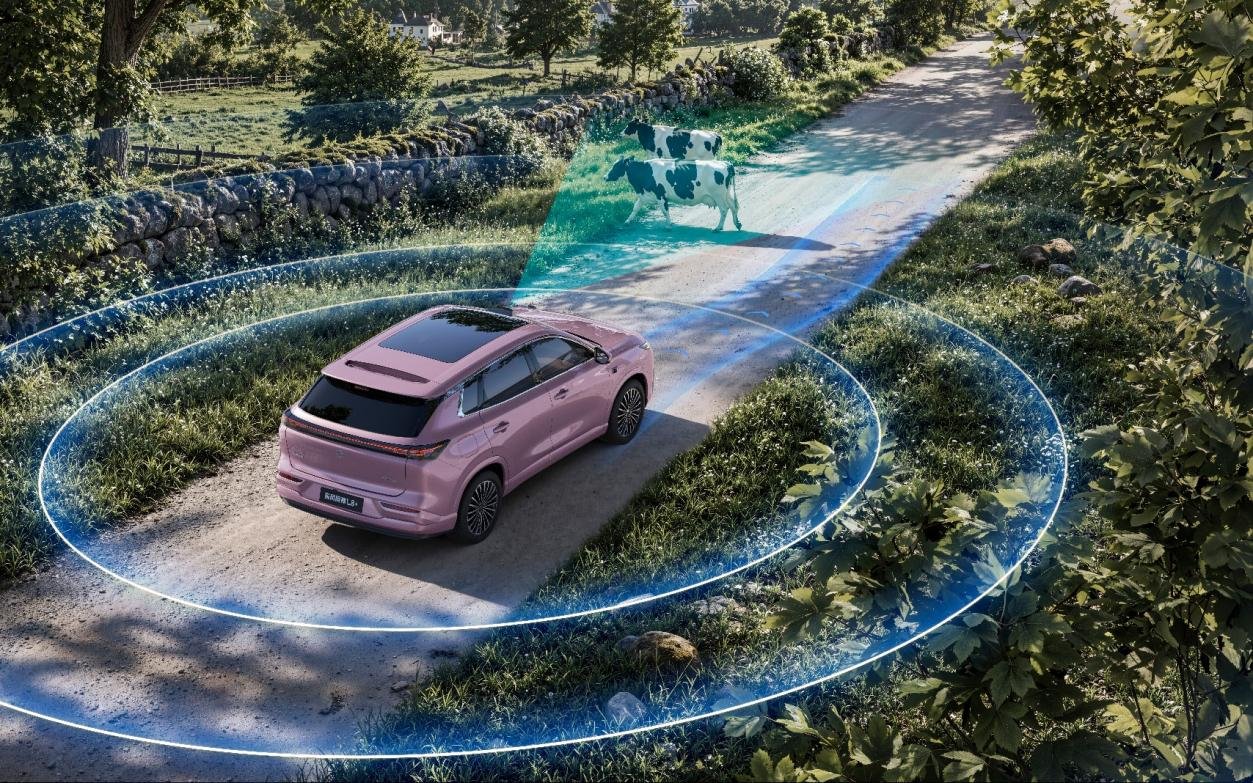
What the Dongfeng Aeolus L8+ does is cut this ladder off directly. It is equipped with the NVIDIA Thor-U chip, with 700TOPS of computing power, making it the only SUV under 150,000 yuan to reach this level of computing power, 3.5 times the mainstream computing power in its class, paired with 1 LiDAR and 26 perception hardware components, with hardware redundancy sufficient to support software iterations over the next 5 years.
More critical is the algorithm. The Tianyuan Intelligent Driving T800 integrates the Momenta R7 world model and is among the first production models to achieve the full R7 functionality, with no need to wait for an OTA. The most notable difference between R7 and R6 lies in whether it truly achieves "parking-space-to-parking-space without interruption"—and the Dongfeng Aeolus L8+ does: starting intelligent driving with one tap from the origin parking space, autonomously driving out of the parking lot, passing through urban NOA, highway NOA, and rural NOA, and automatically parking into a space at the destination, with zero takeovers throughout.
What does this mean? It means that for the first time, users of 150,000-yuan-class family cars can obtain high-level intelligent driving that is "dare to use and easy to use" at a price they can afford. Dongfeng giving its best and newest intelligent driving technology to Aeolus is essentially doing one thing: turning intelligent driving from a "premium configuration" into a "national configuration." The industry significance of this move is no less than when ESP was first extended from luxury cars to compact cars.
Everest 108 Turns, a "limit public test" without rehearsal
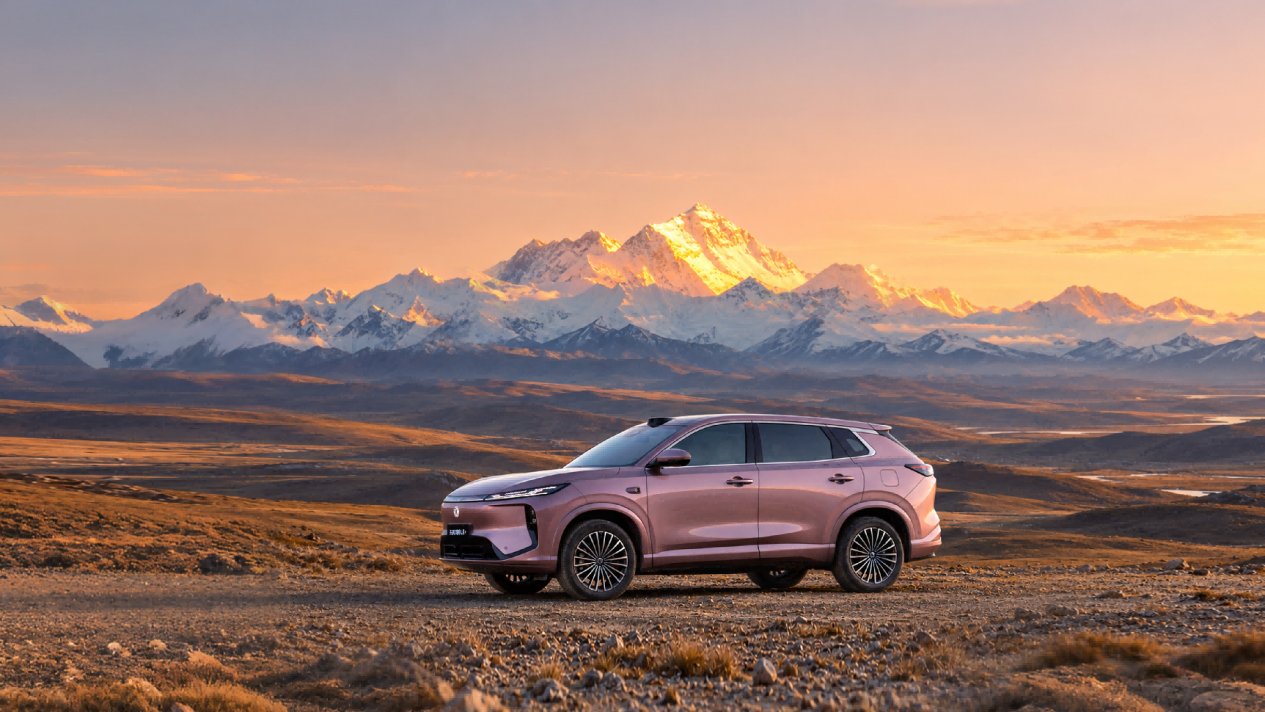
Prices can be set, but technology cannot be boasted. The Dongfeng Aeolus L8+ chose the exam venue least suited to "telling stories"—Everest 108 Turns.
With an average altitude of nearly 5,000 meters, continuous hairpin turns, trucks driving close by, cattle and sheep darting out at any time, as well as construction occupying lanes, road sections without markings, and no high-precision maps. What participated in the test were factory production vehicles, consistent with the sales versions consumers buy. CCTV supervised the entire process, in one continuous shot, with no rehearsal and no NG, and zero takeovers throughout the 73-kilometer route.
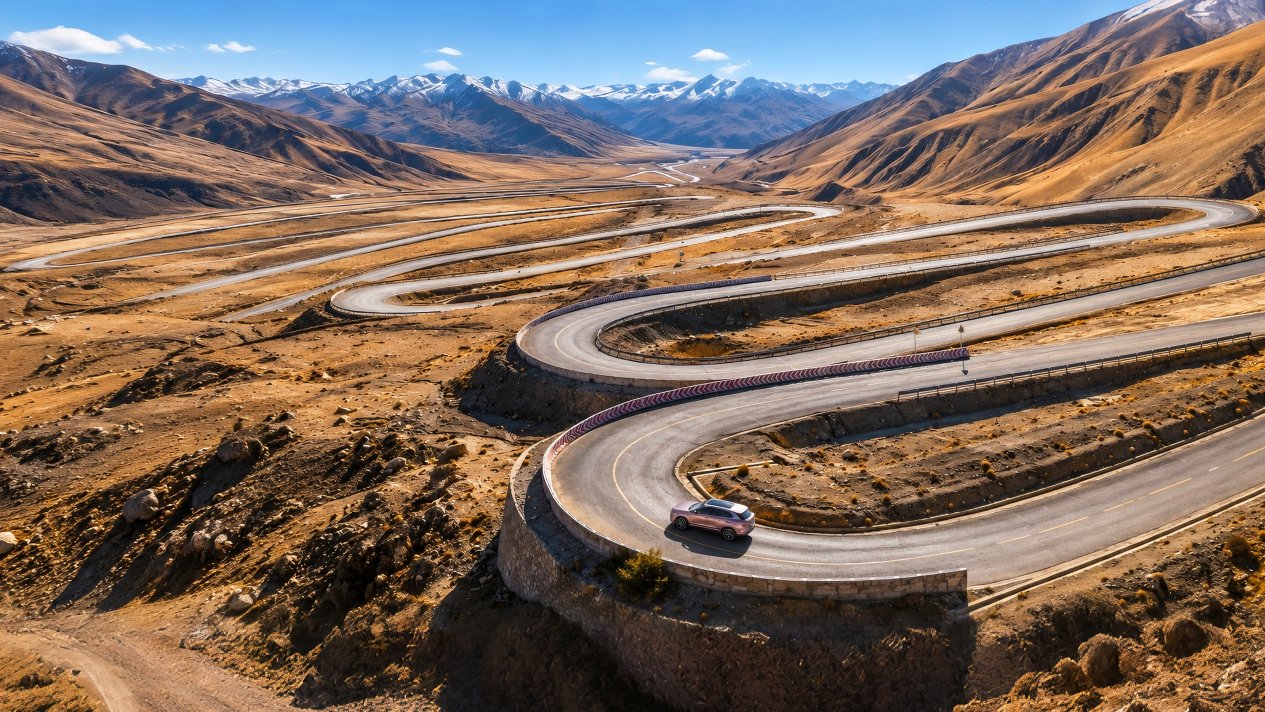
The value of this set of data lies in the fact that what it verifies is not theoretical peak performance in a laboratory, but comprehensive capability under high-altitude low-oxygen conditions: power that does not decay, handling that does not lose control, and perception that does not fail. The perception, computing power, and R7 world model decision-making capabilities of the Tianyuan Intelligent Driving T800, the power stability of the 4-speed Mach hybrid, and the tuning foundation of the track-level chassis were all pushed to the limit in one test.
The more extreme verification there is, the more confidence is delivered to users. If it can climb Everest, then confidence for daily commuting and long-distance self-driving naturally follows.
4-speed Mach hybrid, the SUV most suitable for long-distance driving, is not a slogan
Beyond intelligent driving, another trump card of the Dongfeng Aeolus L8+ is the 4-speed Mach hybrid, a 30.3kWh large battery, 220 kilometers of CLTC pure electric range, and comprehensive range exceeding 1,500 kilometers, with no need to recharge midway from Chengdu to Lhasa. The 1.5T turbocharged hybrid dedicated engine has a thermal efficiency of 45.18%, and authoritative testing shows comprehensive fuel consumption as low as 2.4L/100km.
The 4-speed series-parallel + E-CVT power-split integrated hybrid brings a direct experience: more powerful, smoother, and more fuel-efficient. With a turbo at high speeds, power is strong; in urban areas, high efficiency saves more fuel; and even in a low-battery state, it still does not falter. Combined with 3C fast charging and 6.6kW external discharge, both long-distance travel and outdoor scenarios are covered.
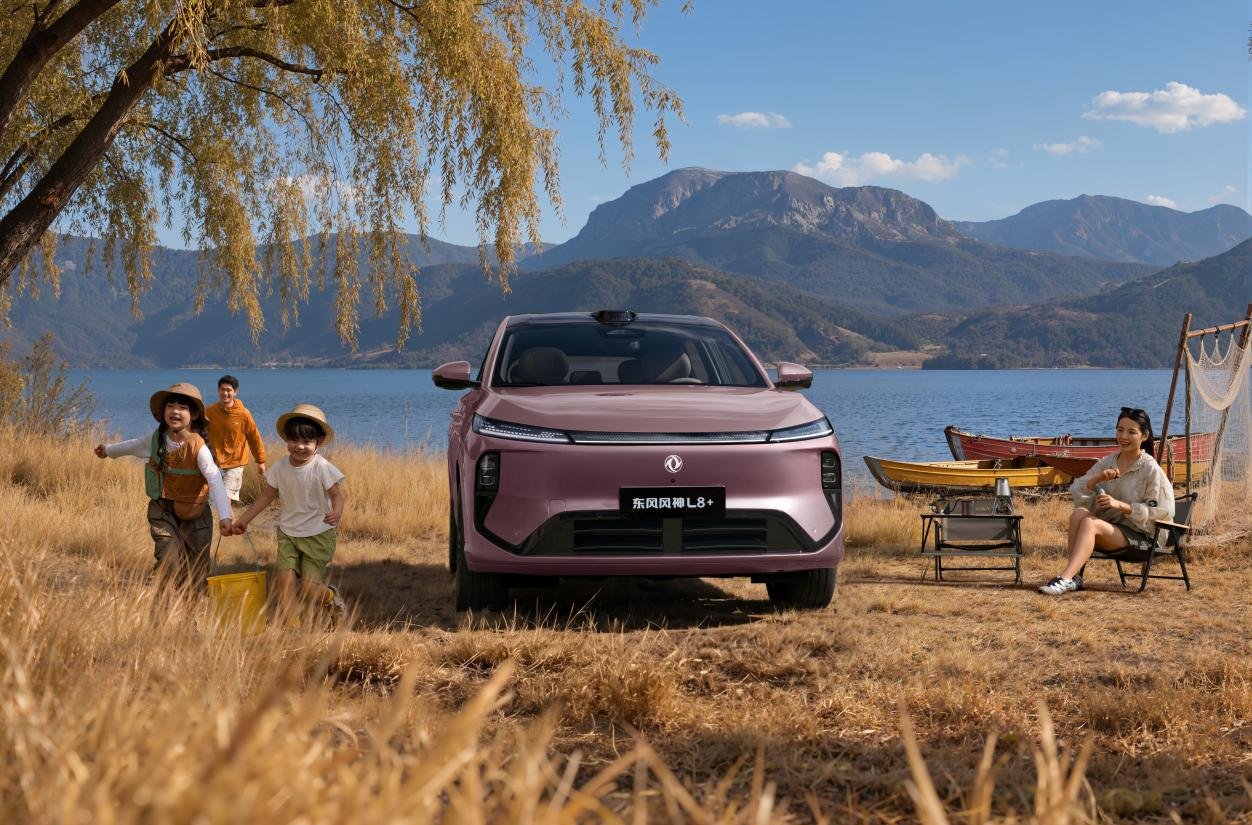
For family users, under the label "the safest SUV for long-distance driving," intelligent driving is responsible for active safety, while the Mach battery is responsible for passive safety. 1200MPa military-vehicle-grade armored protection, 5 times the new national standard safety standard, no fire, no explosion, no leakage, plus three-electric spontaneous combustion coverage that is "not limited to the first owner and not limited by mileage"—the underlying strength of central SOE Dongfeng is shown very directly here.
Comfortable luxury cabin, 150,000-yuan-class price, 300,000-yuan-class feel
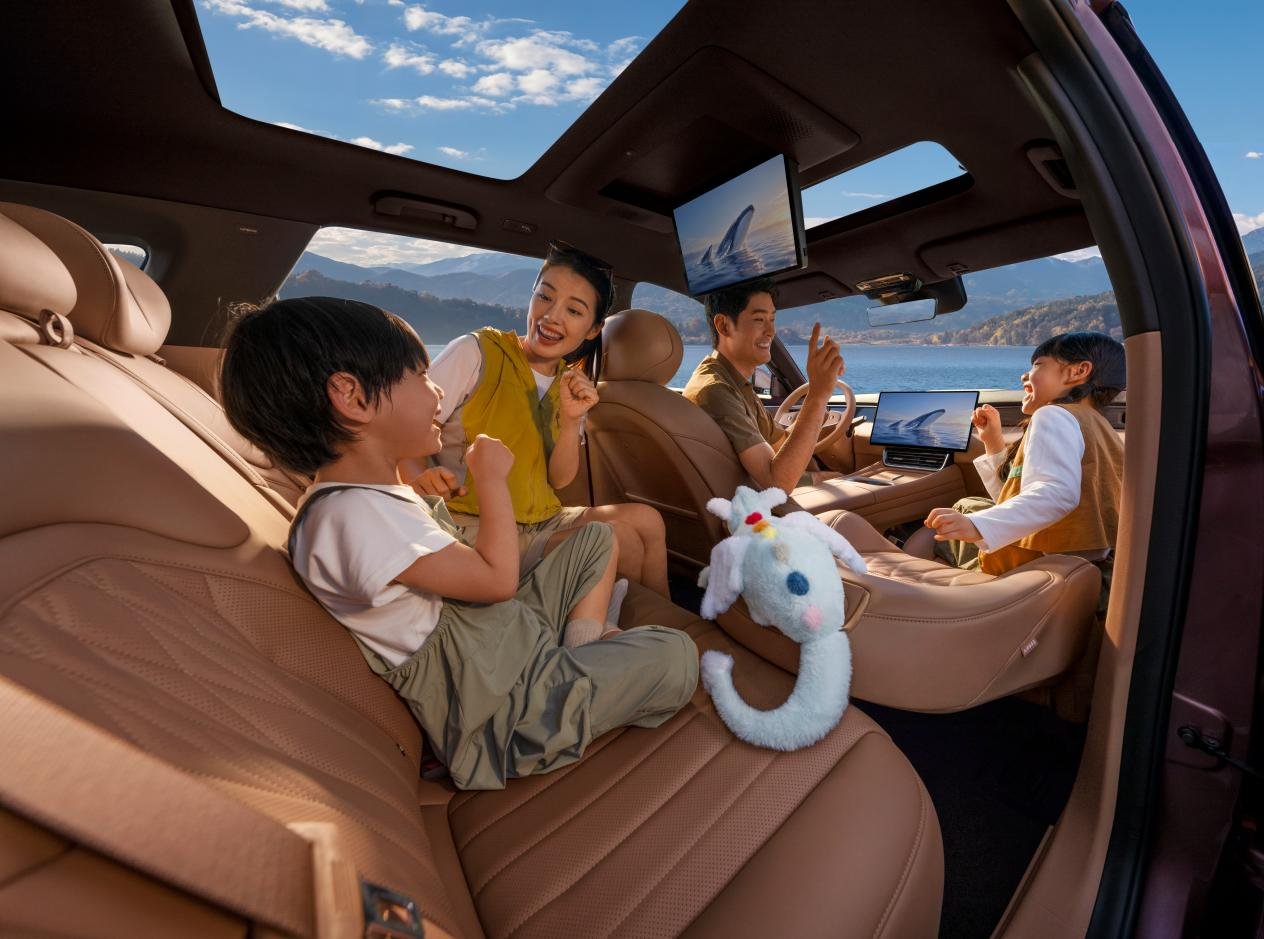
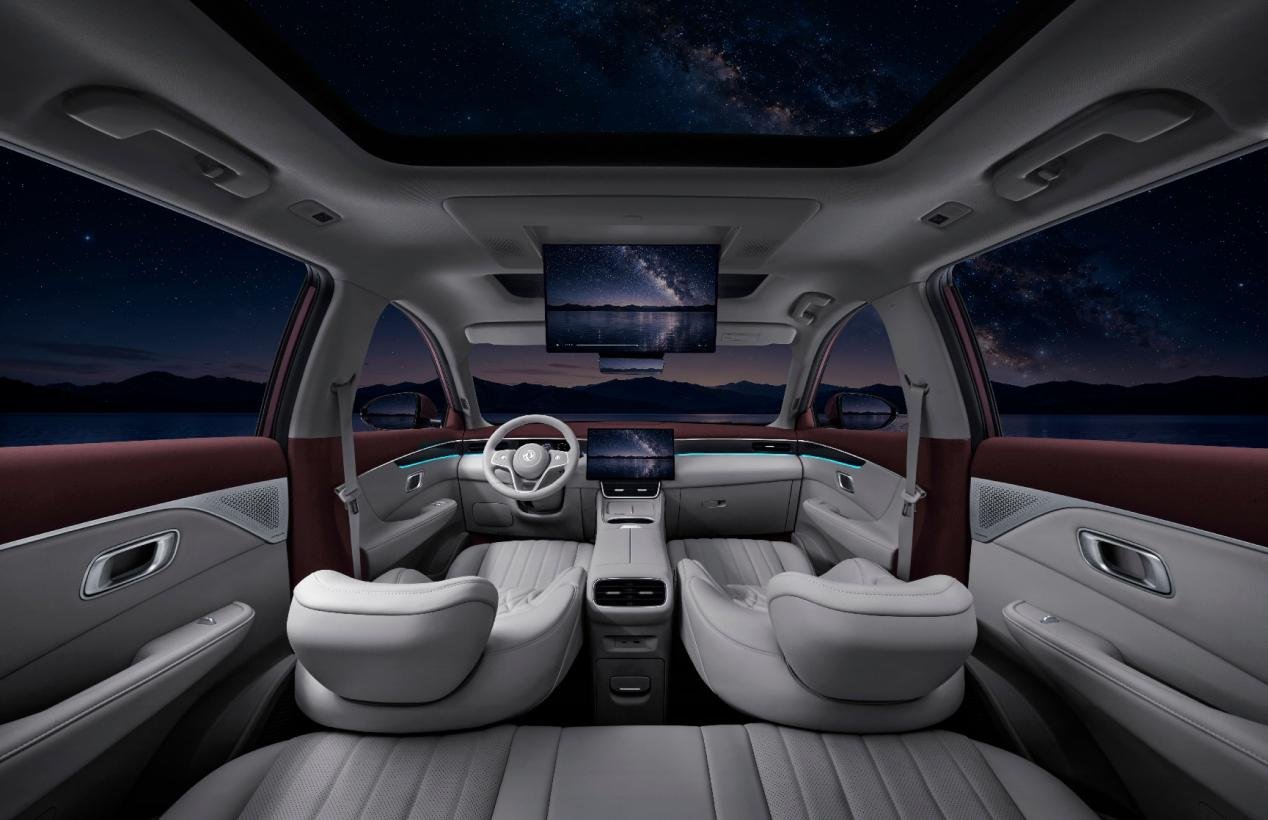
The Dongfeng Aeolus L8+ comes fully equipped at once with the "five luxury-car items" inherited from the Aeolus L8: cloud-soft large sofa, rear ceiling-mounted entertainment screen, rear heating and cooling box, aviation-style small table, and 19-speaker WANOS panoramic sound system. This upgrade adds a capacitive steering wheel/heating, standard memory/welcome/ventilation for the driver and front passenger seats, and heating for all seats front and rear, maximizing the comfort experience of rear-seat family members.
In terms of the intelligent cockpit, Tianyuan OS 2.0 is paired with the Qualcomm Snapdragon 8295 chip, 24G running memory + 256G high-speed storage, four-zone voice, six major intelligent agents, and the Qianwen large model onboard for the first time, connecting the Alibaba ecosystem and providing one-stop solutions for navigation, travel, reservations, and payment. The NFC key works even without power, sentry mode is standard across the lineup, and there is 360° high-definition imaging + 24-hour recording.
Certified by CATARC as a "zero formaldehyde" vehicle, the new car has no odor, so elderly people and children can sit with peace of mind. These details stacked together point to one conclusion: the Dongfeng Aeolus L8+ is not a "single-event champion in intelligent driving," but an all-around contender that delivers all five core needs at once: intelligent driving, comfort, intelligent cabin, range, and safety.
Final thoughts
The launch of the Dongfeng Aeolus L8+, on the surface, looks like a product release, but at a deeper level it is a correction of the industry's pricing logic. With 700TOPS computing power, the Momenta R7 world model, the 4-speed Mach hybrid, and the five luxury-car items, it proves that 150,000-yuan-class family SUVs do not have to compromise on intelligent driving, nor do they have to make do on comfort.
The label "the strongest intelligent driving in the 150,000-yuan class with the only 700TOPS computing power" is not marketing rhetoric, but a fact that can be verified by CCTV live broadcast, Everest 108 Turns, and zero takeovers by a factory production vehicle. Dongfeng gives its best intelligent driving technology to Aeolus, and Aeolus brings it to a price band that thousands of households can afford.


