
In a fast-paced society where efficiency and results reign supreme, if this deal doesn't exist at all, how much genuine care is left in the service? And is it even worth spending time on?
For salespeople, this question is indeed worth pondering.
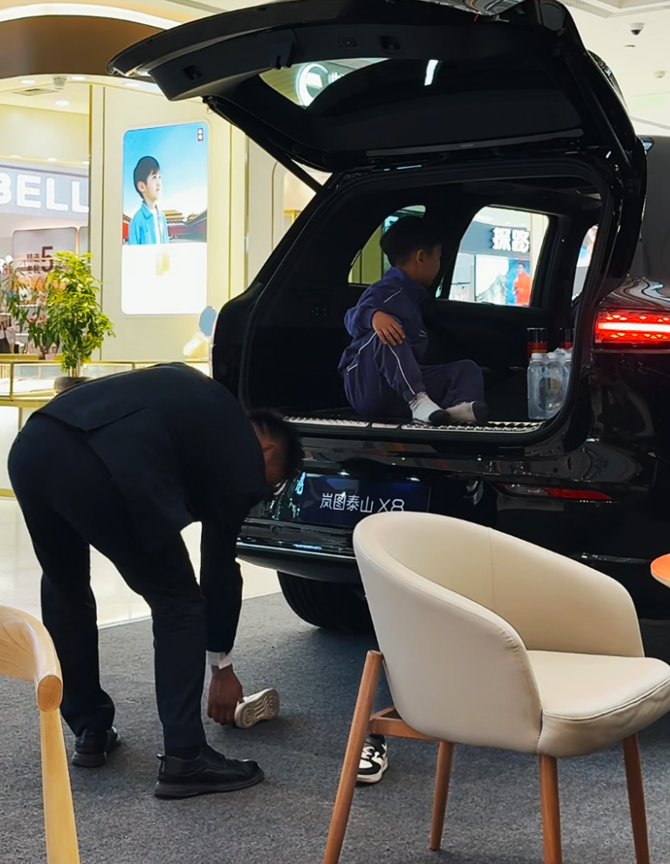
Recently, at an auto show in Ili, Xinjiang, a little boy kept asking questions around a display car. The salesperson didn't brush him off just because he was a child. Instead, he answered every configuration question one by one, opened the one-touch bed mode, and let him and his sister get in the car to experience it. The child took off his shoes and climbed onto the seat, and the salesperson bent down and arranged those little shoes neatly.
The child's mother filmed this scene and posted it online with a caption: "Thank you for patiently receiving a customer who won't buy anything." The video received over 200,000 likes from netizens.

This sentence lays bare an unspoken secret of the service industry: many interactions have already been calculated before a word is spoken—will this person buy, is it worth spending time on. Once you start calculating this, service becomes screening. But that salesperson who bent down to arrange the shoes didn't make that calculation. What he saw first was a child full of curiosity about cars, and only then a "visitor who won't close a deal anytime soon."

See the person first, then see the sale
The real problem in the service industry is often not a bad attitude, but that the scale in people's minds starts tipping too early. Big customers get enthusiasm, ordinary visitors get business as usual, and when a child comes—many salespeople's first reaction is "just don't let them dirty the car." This differential treatment may not come from malice, but from an instinct under the logic of efficiency. Yet it is precisely this instinct that exposes a brand's true attitude toward "people."
The choice of that Voyah salesperson is moving precisely because it goes against instinct. When the child asked about configurations, he answered seriously; when the child wanted to experience it, he opened the one-touch bed mode; when the child took off his shoes to get in, he casually arranged the shoes neatly. From product introduction to a small unnoticed gesture, this salesperson didn't skip the patience he owed just because the other party was a child. This isn't some profound business strategy—it's even hard to write into KPI assessments. But it is exactly the rarest foundation of brand service—maintaining the same respect for every person who walks in.
Behind the coincidence is a consistent choice
Looking at this scene alone, people easily attribute it to the salesperson's personal kindness. Kindness is certainly precious, but if a brand's service warmth depends only on individual employees' improvisation, then it's not sustainable. What's truly worth asking is: did this choice happen only once?
The answer lies in those moments not recorded by trending topics. A car owner in Songzi, Hubei had an accident, with the door severely damaged, and the Wuhan user center arranged for staff to drive a loaner car nearly six hundred kilometers round trip to the scene that same night; a boy with autism loved going to a Voyah store to sit in the car and listen to music, and the salesperson not only patiently accompanied him but also specifically topped up a music account so he could listen to a complete song.
These things happened at different stores, with different employees, in different scenarios, yet they point to the same logic: see the person first, then solve the matter. When a brand's way of serving repeatedly shows the same choice in different corners, it is no longer a coincidence but a stable corporate character.
Doing what you say is the simplest form of integrity
Nowadays all kinds of brands have published service philosophies. The words are always beautiful, but service brands most easily become slogans hanging on the wall. The truly difficult part is not proposing a philosophy, but whether the front line is still willing to practice it again and again after it's published.
That salesperson who bent down to arrange the shoes probably never thought he was "fulfilling" Voyah's "wholehearted" service philosophy. He just did what he believed was right. But it is precisely this unforced naturalness that best demonstrates whether a brand's value philosophy has truly reached the front line through daily employee training. If "wholehearted" exists only in press releases, ordinary interactions won't change; if it has truly seeped into daily life, a child's removed shoes will be arranged neatly.

Saying and doing, and persisting once you've done it—this itself is a form of integrity. Integrity is not only about honoring car-selling commitments to users, but also about whether a brand fills its publicly stated service philosophy with action after publishing it. No matter how loud the slogan, it's empty on the wall; only when ordinary interactions truly change does that sentence carry weight.
Human warmth is a difference that can't be replicated by competition
In today's auto market, prices can be cut, features can be added, marketing rhetoric can be copied, but whether a salesperson is willing to treat someone who won't buy a car with seriousness—competitors find that hard to replicate. This isn't a matter of specs, not a matter of budget, but a matter of how a company understands people and how it treats people.
The more competitive the auto market becomes, the more everyone tends to fixate on sales and conversion, and human warmth becomes a scarce commodity. And precisely because it's scarce, once users feel it, they remember it for a long time. That mother in the video wished the salesperson to "become the top seller" and wished Voyah "great sales"—she had no plan to buy a car, but she had already spoken for this brand. An interaction with no expectation of a sale earned the child's mother's sincere gratitude and also made more netizens feel favorably toward Voyah.
Sometimes, not rushing to close a deal反而 lets people see something more precious beyond business. A brand willing to bend down deserves to be seen by more people.